


Worms in the human body are parasites that cannot exist on their own but can only survive and reproduce through a host (human or animal).Parasitic diseases can be caused by the worms themselves or by their larvae.The disease is spread through infection;Helminth infections often go unnoticed, gradually causing disorders in the body.
First of all, you should understand what helminths are.This is a general term to refer to parasitic worms on the human body, animal body or even plants.This explanation is also the answer to the question of what worms are.The terms “worm” and “helminth” are synonyms.
The most dangerous helminth infection is the form that has no long-term symptoms, leading to disease due to lack of nutrients.Intestinal parasites live by absorbing nutrients from the human body.Helminth infections can be detected in an advanced stage, after the appearance of other symptoms of the presence of intestinal parasites.
Some intestinal parasite larvae can reach various body tissues.In this case, inflammatory substances are formed because the immune system recognizes the larvae as foreign organisms.Due to the presence of helminths in humans, certain allergic reactions of the immune system may occur.
When worms appear in humans, the symptoms and treatment of worm infection are closely related to the elimination of the cause of discomfort, that is, the parasite, and signs of its presence also disappear.
Parasite infection routes
There are many factors that cause worms.Their appearance can be due to the following situations:
- One of the common risk factors for helminth infections is the influence of mass tourism;
- ranked second is water and food pollution;
- You can become infected with helminths after eating meat products and sausages;
- Poorly washed fruits and vegetables are the main source of parasitic larvae;
- Transmission of worms from pets is often documented.
Symptoms of parasitic diseases
Worm infestations can manifest themselves in different ways, depending on the type of parasite.The most common manifestations are as follows:

- constipation - difficulty defecating due to worms - results from obstruction of intestinal flow;
- diarrhea - the appearance of loose stools due to contact with substances secreted by parasites that cause loss of potassium and chloride;
- Bloating and bloating - parasites cause inflammation and gas formation in the small intestine;
- muscle and joint pain - helminth infections are often characterized by the location of the worms even in joint fluid and muscle tissue;
- allergy - parasites perforate the intestinal wall, leading to undigested molecules entering the blood, causing an allergic reaction;
- skin problems – helminth infections often cause skin problems such as pimples, rashes and itching;
- anemia – parasites attach to the intestinal mucous membrane and “steal” nutrients, leading to anemia;
- granuloma - a tumor-like growth formed around the eggs of the parasite;
- anxiety – worms produce toxins that irritate the central nervous system, as a result – psychological signs may appear;
- sleep disorders - nocturnal restlessness accompanies helminth infections for the following reasons: at this time the worms leave the rectum, liver activity increases, trying to eliminate toxins produced by them;
- Chronic fatigue is one of the first signs of parasites in the body;
- cancers.

Pinworms
Pinworms are one of the most common intestinal parasites in the human body.These worms have the scientific name Enterobius vermicularis.They are distributed worldwide.Despite the fact that these worms are mainly characteristic of the children's body and are most common in the children's group, they are also found in adults.
Infection occurs when parasite larvae ingest anywhere in the infected person's environment.They are present on the skin, under fingernails, on bed sheets, on clothing and in dust.In the duodenum, the larvae develop into adult parasites, which then migrate to the large intestine.
Adult pinworms are about 1 cm long and thin, like a white thread.They lay eggs in the area around the anus.This is expressed by the most characteristic symptoms of the disease - discomfort and itching in the rectal area.
Complications of infections caused by parasites are manifested by chronic inflammation of the intestines, and in girls - secondary vaginal infections.
Two-thirds of people infected with intestinal parasites are unaware of the presence of helminths because they often do not feel symptoms other than anxiety, irritability and fatigue.
roundworm
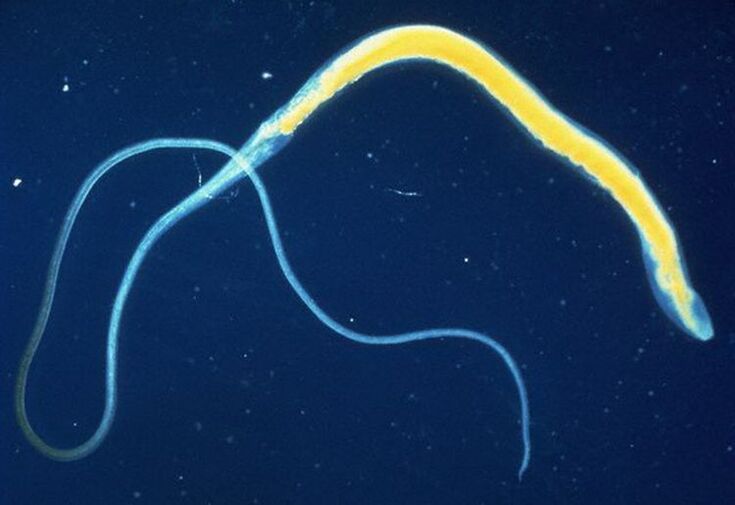
The second most common intestinal parasite is the whipworm Trichuristrichiura.Infections caused by this worm are often asymptomatic, so it is difficult to accurately identify the infected person.
Adult whipworms are 3–5 cm long.Helminth infection occurs orally - through consumption of contaminated food or water, as well as through contaminated soil.The parasite's larvae hatch in the small intestine and the adult worms nest in the large intestine.Adult females lay eggs in feces and hatch in warm soil after nesting for 5 weeks.
At worst, whipworms cause abdominal pain, diarrhea or nausea.More serious complications of this infection occur only in tropical regions.In severe cases, chronic diarrhea or anemia may occur.
Nematodes
Human nematodes include two types of parasites: Ancylostomaduodenale and Necatoramericanus.Adult females are 10–13 mm (A. duodenum) or 9–11 mm (N. americanus) long, males are 8–11 mm (A. duodenum) and 7–9 mm (N. americanus) long.
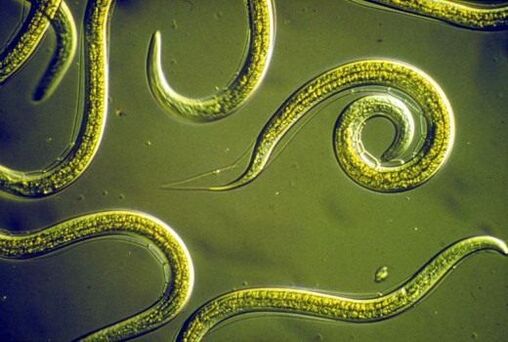
Eggs are released from the host's body in feces.Under favorable conditions (humidity, temperature), larvae hatch within 1–2 days in the soil or in feces and after 5–10 days they become larvae capable of transmitting diseases.Under favorable natural conditions, they can survive for 3-4 weeks.
Contact with the human body occurs through the penetration of parasite larvae through the skin.Through the bloodstream, they reach the heart and lungs, enter the pulmonary alveoli, then from the bronchial tree they enter the throat and a person swallows them.The larvae reach the small intestine, where they survive for the time necessary to develop into adult worms.
Adult worms live in the small intestine, attach to the intestinal wall and suck blood from the human host.Most of these parasites are eliminated from the body within 1–2 years, but the record of their parasitism in the body can last for decades.
A. duodenum larvae burrow into inactive human skin (whether in the intestines or muscles).In addition, A. duodenum parasitic infection can also be transmitted orally.However, the N. americanus worm needs to migrate.
Roundworm
Roundworms - Ascarislumbricoides - are also intestinal parasites.An adult worm can be up to 25 cm long.Human helminths of this type remain hidden for a long time.Their symptoms are usually fatigue and cough, which in most cases are due to other reasons.
To get infected with helminths, it is enough to eat unwashed vegetables and fruits.
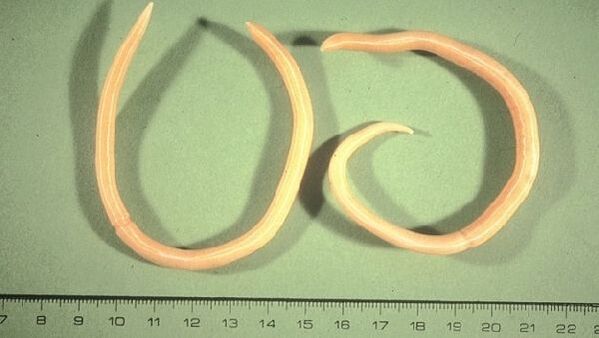
The larvae of these worms nest and hatch in the small intestine and penetrate the intestinal wall.They reach the lungs through the blood and lymph streams, causing coughing.When coughing up green mucus, the roundworm will return to the intestines after being swallowed.Roundworm eggs are excreted in feces.
The most common source of infection between people is infected human feces.
In severe cases, roundworms can cause inflammatory processes in the body, most often pneumonia.However, in most cases, people infected with worms remain asymptomatic or the symptoms are so mild that neither the patient nor the doctor initially suspects intestinal parasitic infection.
The disease caused by roundworms is called ascariasis.The main route of infection is through the fecal-oral route.
According to WHO estimates, the incidence of helminth disease is about 1 billion people each year.
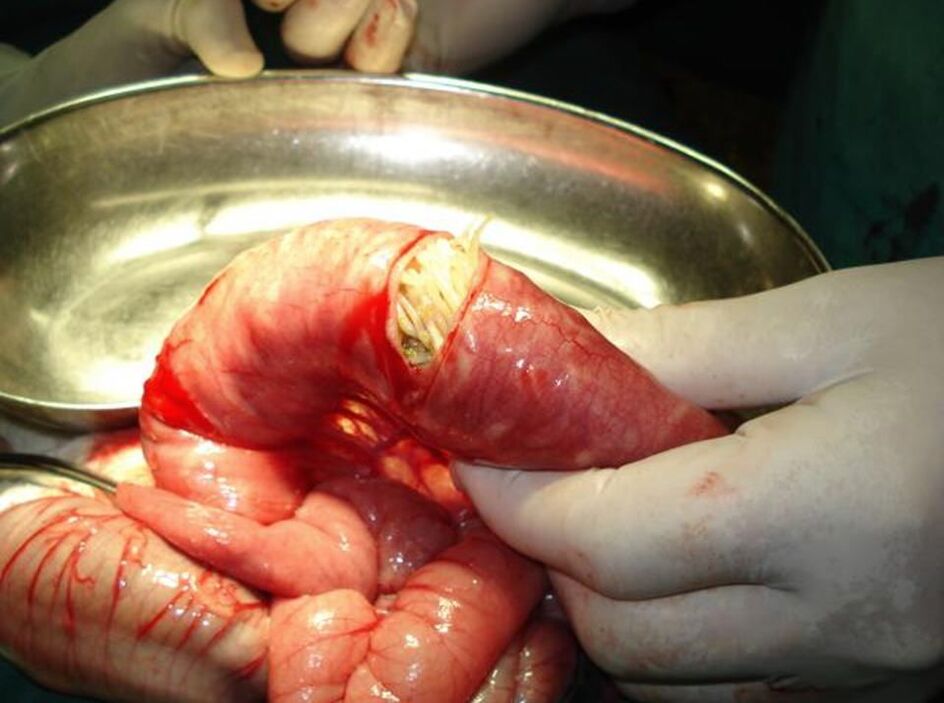
Helminths in adults, the symptoms and treatment of which depend on the location of the worm, are characterized by a variety of clinical manifestations - from asymptomatic forms to severe, even fatal cases.Common symptoms include abdominal discomfort and pain, diarrhea, itching in the rectal area or allergic manifestations.During the first - migratory - stage, the parasitic larvae can cause signs of inflammation in the lungs (Loeffler syndrome), pancreas, myocardium, liver and other organs.
Roundworms in the intestines are the cause of metabolic disorders and nervous system disorders.
Roundworms in the respiratory system
As the worms move through the human body, they pass through the pharynx, where they invade the lymph nodes surrounding the main lymphatic chain (Waldeyer's chain).
Where worm larvae may be found:
- lymph glands and salivary glands;
- pharynx;
- larynx;
- the area along the ear canal leading into the middle ear;
- All passages lead to the brain.
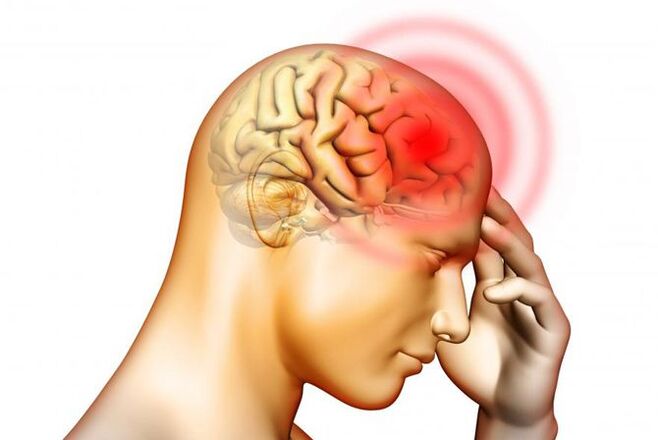
On the lateral wall of the nasopharynx there are openings leading to the Eustachian tube, which connects the pharynx with the middle ear.This allows the pressure in the ear to be properly balanced with atmospheric pressure.Through these pathways, worm larvae can reach the middle ear.The result is impaired hearing, tinnitus, headaches and Meniere's syndrome - dizziness, accompanied by periods of memory loss.
Pulmonary manifestations of roundworms
When roundworms enter the lungs, they will cause diseases of this organ and skin signs such as roughness and rashes.These symptoms are accompanied by a slight increase in temperature, but sometimes there is a fever.People with dry cough, asthmatic bronchitis and hoarseness.Without treatment, lung nematodes can develop into chronic problems with seasonal exacerbations and eventually cause severe asthma.A person becomes dependent on medication, and sometimes even has to receive disability benefits.
Roundworms in other organs
Because the worm larvae invade other organs, slight bleeding and signs of inflammation appear.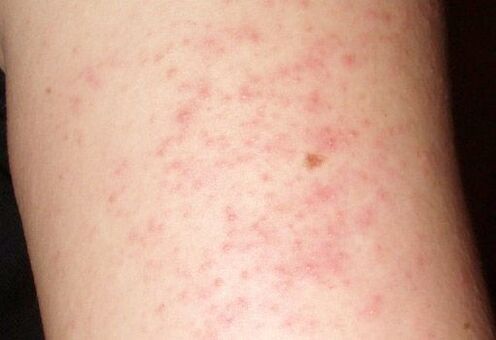 They can enter the pancreas, bile ducts, and liver.In the small intestine, the larvae coalesce into a "clump", causing intestinal obstruction.Parasitic larvae live in the above-mentioned organs throughout human life, feeding on their metabolites and causing mechanical damage.
When larvae are present in the liver and bile ducts, the liver will be weakened and unable to naturally eliminate toxic substances.As a result, they are excreted through the skin, causing allergies, itching, swelling under the skin of unknown origin and other manifestations with many variations, from dry eczema to purulent disease.
Roundworms in the brain
Symptoms of brain infection vary depending on the location of the worm larvae.If they are located in the meninges, there is a risk of meningoencephalitis with migraines.When the grooves invade the gray crust, a granuloma forms.
Later, symptoms of brain carcinoma appear: loss of consciousness, epilepsy, convulsions.If the granuloma is located near the optic or auditory nerve, deafness or visual impairment will occur.
Tapeworm
Tapeworms – Taeniasaginata, Taeniasolium – are among the oldest and best-known intestinal parasites.It can reach a record length - up to 9 m.
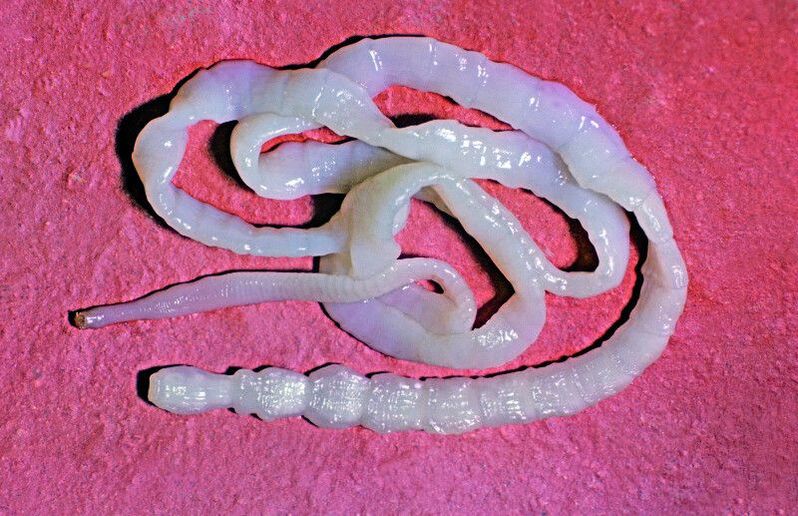
The two most common types of worms are beef tapeworm (Taeniasaginata) and pork tapeworm (Taeniasolium).Both types invade the body after eating raw or improperly cooked meat.The parasite's eggs are long and laid in the small intestine.Adult worms develop after 3 months.The ends of the worm's body are filled with eggs, which are released individually and excreted in feces.The larvae are able to enter the bloodstream through the intestinal lining, then migrate into the muscles and brain, where they settle.
Despite the severity of the disease, tapeworms do not necessarily cause immediate symptoms so they go unnoticed for a long time.Tapeworms in the muscles cause muscle pain, in the brain - cause epilepsy.
Parasites are detected by X-rays or computed tomography.The correct diagnosis can only be determined based on these studies.
Parasite treatment
Treatment methods for worms are very diverse.These include both the folk use of anti-parasitic herbs and the most modern bioresonance therapy.
Anti-parasitic herbs
The principles of using anti-parasitic herbs are based on the location of the worms in the body.

It should be taken half an hour before meals in the following cases:
- parasites in the intestines and lower body;
- Secondary infection with worms of the genitourinary system.
Take with food: Parasites cause damage to the stomach, colon, liver, and spleen.
Use after eating: parasites cause damage to the upper body, lungs, neck, and head.
Recommendations for using anti-parasitic herbs:
- Not recommended for pregnant women;
- One of the most popular deworming plants - Mugwort - should not be used to treat stomach ulcers.
Chemical antiparasitic drugs
Preparations containing carbamic acid methyl esters are considered the most effective.This active ingredient is used to treat pinworms, roundworms, roundworms and tapeworms.When treating pinworms, the dosage is taken according to the instructions.Other types of parasites should be treated with these medications depending on age.
It is important to adhere to the dosage to avoid cramps.

Treatment is by applying therapeutic frequencies on a bioresonance device and using a plasma generator
These devices kill pathogens in the body without any negative side effects.When using a bioresonance device, electrical impulses will travel through the tissues;When using a plasma generator, radio waves pass through the tissues, causing vibrations of the parasite membranes.As a result, the membrane ruptures and thus the parasite is destroyed.For each type of microorganisms, a certain frequency is applied.
During the treatment of this worm, it is very important to adhere to the measures of the regimen: avoid drinking alcohol and detoxify afterward.Dead worms must be expelled from the body, otherwise they will encapsulate and act as allergens.
Treatment with these methods will destroy all parasites present.Treatment is carried out in 2 stages:
- stage 1: removal of small parasites – 20 minutes per microorganism;
- stage 2 – removal of large worms – frequency is first applied to destroy eggs, then larvae and finally adult worms.
Optimal treatment time:
- Single cell: plasma – 5 minutes at 1 frequency;Bioresonance – 20 minutes per frequency.
- Multicellular: plasma – 10 minutes at 1 frequency;bioresonance – 4×20 minutes using 1 frequency.
The use of a plasma generator, in addition to significantly reducing the execution time, has another big advantage - when using it, up to 5 people can be present with the animal at the same time.Its range is up to 5 m.
Conclude
Treatment of worms includes eliminating sugar, pastries and potatoes - these products create an ideal environment for the survival of helminths.
When treating a child, it is recommended to give him or her to chew roasted pumpkin seeds - about 30 seeds 3 times a day.Do not eat them with main meals.
Eating moderate amounts of raw garlic will also help kill worms.
Worms cannot be removed without proper cleaning.Hand washing and regular washing of bed linen and dishes are the basis of effective treatment.